
Understanding Appendicitis
What just happened, what comes next, and what to expect from surgery.
Welcome
If you've been told you have appendicitis, things are probably moving fast. You went to the emergency room with belly pain, got a scan, and within a few hours a surgeon is talking to you about taking out your appendix.
Appendicitis is one of the best-understood problems in surgery, and the operation that fixes it is one of the most common in the world (about 300,000 a year in the US). For an uncomplicated case, you'll usually go home the same day or after one night, and be back to normal daily life inside a week or two.
How to use this guide. If you are reading this in the emergency room or before surgery, start with Chapter 3 and Chapter 5. If you are reading after the operation, jump to Chapter 6 and Chapter 8. The questions in Chapter 9 are designed to bring to your follow-up visit.
What is appendicitis?
Appendicitis is what happens when your appendix gets blocked, swollen, and infected. It's one of the most common reasons adults need urgent surgery. About 1 in 12 people will have it at some point in life.
The appendix
Your appendix is a small finger-shaped pouch at the start of your large intestine. It sits in the lower right side of your belly. It is about 3 to 4 inches long and as wide as a pencil.
For a long time, doctors thought the appendix had no job. Current thinking is that it may help gut bacteria reset after an illness, but you can live a normal life without it. Patients who had theirs out years earlier rarely think about it again.
What goes wrong
Appendicitis starts when the inside of the appendix gets blocked, usually by a small piece of hard stool (a fecalith) or, less often, by swollen lymph tissue from a recent illness. Once it's plugged, fluid and bacteria build up behind the blockage, the wall swells, and the blood supply to the wall gets squeezed off. If nothing is done, the wall eventually breaks open and spills infection into the belly.
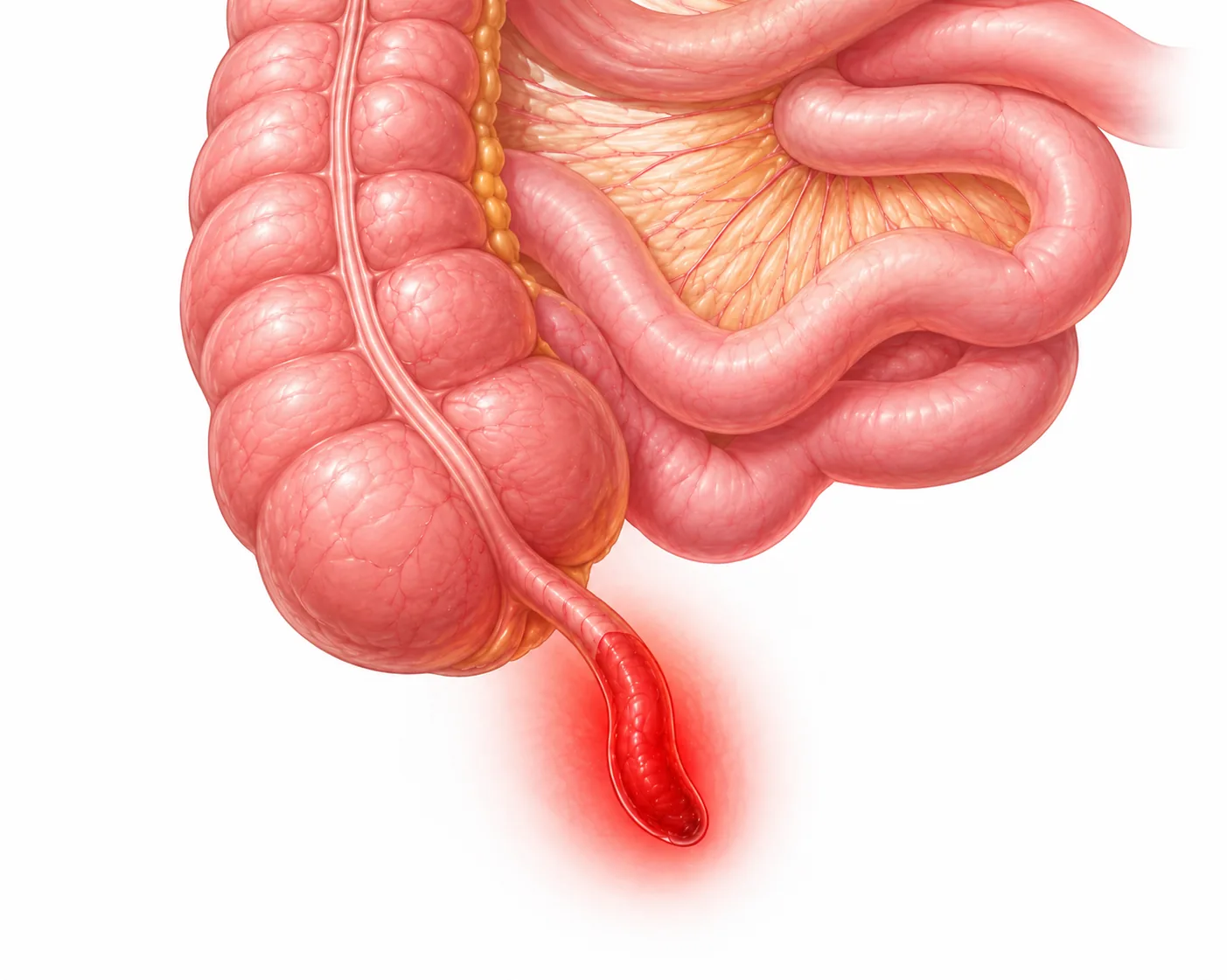
The first question most patients ask is what they did to bring this on. The answer is nothing. Appendicitis happens when the small opening of the appendix gets blocked, and there is no diet, supplement, or behavior change that prevents that from happening.
Why this is urgent
A swollen, blocked appendix can break open if it isn't treated, and once it ruptures the infection spills into the belly. The goal is to take it out before that happens, which is why your team is moving quickly.
The timeline
The classic teaching is that an inflamed appendix can rupture within 24 to 72 hours. In practice, the timing varies a lot from one patient to the next. Some appendices stay mildly inflamed for days, and others rupture within hours of the first ache. There is no reliable way to tell ahead of time which course yours will take. The safest assumption is that the clock is running.
What happens if it ruptures
- Local infection. A pocket of infection forms next to where the appendix used to be. This pocket is called an abscess.
- Spreading infection. If the infection spreads through the belly, the lining can become inflamed. This is called peritonitis. It causes severe pain and can make you very sick.
- Longer treatment. A ruptured appendix often means more days in the hospital. You may need IV antibiotics. The recovery is slower.
If your appendix hasn't ruptured yet, prompt surgery almost always heads off these problems and most patients leave the hospital with nothing on this list. Even when rupture has already happened, modern surgery and antibiotics usually handle it well.
Some patients want to wait a day or two and see if it settles down on its own. The trouble is that the appendix is blocked and inflamed. Every extra hour raises the chance of rupture, infection, and a harder recovery. Most adults are better off having surgery the same day they are diagnosed.
Appendicitis in pregnancy is treated promptly because the risks of waiting are higher for both mother and baby. The surgery is safe in pregnancy. Your team will use ultrasound or MRI to confirm the diagnosis instead of CT when possible.
How the diagnosis is made
The diagnosis usually starts with the story you tell in the ER. The exam, blood tests, and a scan fill in the picture. Most adults get a CT scan because it is the most accurate test.
The classic story
- Pain that starts near the belly button. It often begins as a vague ache around the middle of the belly.
- Pain that moves to the lower right. Over hours, the pain shifts and settles in the lower right side. It becomes sharper and more steady.
- Loss of appetite, nausea, or vomiting. Most people feel sick to the stomach. Many cannot eat.
- Low-grade fever. Often around 100 to 101 degrees.
- Pain with movement. Walking, bumps in the car, or even coughing makes the pain worse.
Not everyone has the classic story. Pain in the right upper belly, the back, or the pelvis can also turn out to be appendicitis. The location of the appendix varies a little from person to person.
The workup
- Exam. Your surgeon presses on the lower right belly. The spot they press is called McBurney's point. A spot of sharp tenderness here is a strong clue.
- Blood tests. A high white blood cell count and a high C-reactive protein suggest infection. Both can be normal early on.
- Urine test. To help rule out a kidney stone or urinary infection that can mimic appendicitis.
- Pregnancy test for any patient who could be pregnant.
- CT scan. The most accurate test. The scan shows whether the appendix is inflamed, whether it has ruptured, and whether there is an abscess. Most adults with suspected appendicitis get a CT.
- Ultrasound or MRI. Used in pregnancy or in younger patients to avoid radiation. Ultrasound is the first choice in many children.
CT is the best test available for this, but it isn't perfect. In roughly 5 to 10 percent of operations done for suspected appendicitis, the surgeon finds a normal appendix or a different problem entirely. That number has come down as scanners have improved. When the scan and exam don't line up, your team may admit you for a few hours of observation and recheck your belly and your labs before deciding.
Surgery or antibiotics?
For most adults, surgery is still the standard treatment, but for selected patients with mild, uncomplicated appendicitis, antibiotics alone are a reasonable alternative.
Surgery, the default
Removing the appendix takes care of the problem in one visit. Most people are home within a day. With the appendix gone, the chance of needing more treatment for it is essentially zero. It is the choice most surgeons recommend for most adults.
Antibiotics first, an option for some
For adults with mild appendicitis on the scan, no fecalith, no abscess, and no rupture, antibiotics alone can work. Several large studies have followed these patients for years. About 4 in 10 need their appendix out within the first year. By 4 to 5 years, about half have had it out. The other half get through on antibiotics and never need surgery.
| Surgery first | Antibiotics first | |
|---|---|---|
| Solves it now | Yes | Most of the time |
| Needs surgery later | No, except rare cases | About 4 in 10 by 1 year, about half by 4 to 5 years |
| Hospital stay | Often same day or 1 night | 2 to 3 days for IV antibiotics |
| Time off work | Usually 5 to 10 days | Often shorter at first; longer if it returns |
| Best fit | Most adults | Mild, uncomplicated cases by scan |
Antibiotics alone are not a safe choice if your scan shows a fecalith, an abscess, a rupture, or signs of widespread infection. In those cases, surgery is the safer path.
Some patients want to avoid surgery during a busy work or travel period and accept the chance of needing surgery later. Talk it through with your surgeon.
The appendectomy
An appendectomy is the surgery to remove the appendix. Most are done with a small camera and a few tiny cuts. Most people are home the same day or after one night.
How the surgery is done
Almost all appendectomies today are done with the laparoscopic approach. You are asleep under general anesthesia. The surgeon makes three small cuts in your belly, each less than half an inch. A camera goes through one. Long, thin instruments go through the other two. The appendix is freed from the surrounding tissue, sealed at its base, and lifted out through one of the small cuts.
| Approach | How it's done | When it's used |
|---|---|---|
| Laparoscopic | 3 small cuts; camera and instruments | The default for most adults today |
| Robotic | 3 small cuts; surgeon controls instruments from a console | An option in centers with the robot; outcomes are similar |
| Single-incision | One slightly larger cut at the belly button | Cosmetic option in selected cases |
| Open | One 2 to 3 inch cut in the lower right belly | Used for complex cases or when laparoscopic is not safe |
What your surgeon may find
- Inflamed but intact appendix. The most common picture. The surgery removes it without complications.
- Ruptured appendix. Found in about 1 in 5 adult cases. The surgery still removes the appendix and washes out the area. You may stay 2 to 4 nights and get IV antibiotics.
- Walled-off abscess. Sometimes the body has already contained the infection. Your surgeon may drain it through the skin first and operate later in some cases.
- A normal-looking appendix. This is rare but can happen. The surgeon will look for another cause. Most of the time, the appendix is still taken out.
How long the surgery takes
For an uncomplicated appendix, the surgery itself usually takes 30 to 60 minutes. With rupture or abscess, it can take longer. Prep, anesthesia, and recovery add more time. Plan for 4 to 6 hours from the time you go to the OR holding area until you are awake in your room.
Recovery, day by day
The first two or three days carry the most soreness, and by the end of week one, most adults are doing their normal daily activities. Heavy lifting and intense exercise wait a bit longer.
Day of surgery
- You wake up in the recovery area. You will feel sleepy for a few hours.
- Some belly soreness is normal. Pain medication helps.
- Many people are sent home the same day if surgery was in the morning. Others stay one night.
- You will be encouraged to walk a little before you go home.
Day 1 to 3
- Walk every couple of hours while you are awake. It helps prevent blood clots and gets your bowels moving.
- Start with light food. Most people can eat a normal diet within a day or two.
- Pain control: most patients do well with over-the-counter pain medicines after the first day or two.
- Shower is usually fine after 24 to 48 hours unless your surgeon says otherwise. No baths or pools yet.
Day 4 to 7
- Most desk workers feel ready to return to work. Many do part-time or remote work first.
- Driving: once you are off prescription pain medicines and can hit the brake hard right away.
- The cuts are healing. Some bruising and tenderness is normal.
Week 2 to 3
- Most people feel close to normal.
- Light exercise, like walking or easy biking, is fine. Heavy lifting, contact sports, and running often wait a bit longer.
Week 3 to 6
- Full activity for most people. Lifting, sports, exercise, sex.
- If your appendix had ruptured, full recovery may take a bit longer. Your team will guide you.
Call right away if you have a fever over 100.4°F, pus or worsening redness around your cuts, vomiting that will not stop, belly pain that is getting worse instead of better, or trouble breathing. These can be signs of a problem that needs prompt attention.
Long-term outlook & follow-up
Once the cuts heal and the soreness fades, the episode is over. Most patients are back to their usual routine within a few weeks.
One follow-up visit
Most surgeons see you once at 2 to 4 weeks after surgery. They check your cuts, ask how you are feeling, and review the lab report from your appendix. After that, you are done. There is no long-term follow-up needed for a simple appendectomy.
Will I get appendicitis again?
No. Once the appendix is out, there's nothing left to inflame. In very rare cases (about 1 in 50,000), a small remnant of appendix is left behind and can become inflamed years later. This is called stump appendicitis, and it's treated the same way, by removing the stump.
The pathology report
Your appendix goes to the lab after surgery. The lab confirms the diagnosis. In a small number of cases, about 1 in 100, the lab finds an unexpected tumor. Most of these are benign or very slow-growing. If anything unexpected shows up, your surgeon will call you and explain the next step.
Living without your appendix
There's no diet to change, no medicine to take, and no impact on your immune system that you'll notice. Most patients stop thinking about it within a few months. The three small cuts fade over the first year, and by year two many are hard to find.
Frequently asked questions
How did I get this?
Most of the time, it is bad luck. The opening of your appendix got blocked, and once that happens, the rest follows. There is no evidence linking it to a specific diet, behavior, or past illness, so when patients ask what they did wrong, the answer is nothing.
How long will I be in the hospital?
For a simple appendectomy without rupture, many adults go home the same day. Some stay one night. If your appendix had ruptured, plan on 2 to 4 nights for IV antibiotics and to make sure things are settling.
Will the surgery leave a scar?
Yes, but small ones. Three half-inch cuts. They fade over the first year and usually become hard to see. Many adults stop noticing them within a few months.
When can I drive?
When you are off prescription pain medicines and can hit the brake hard without flinching. For most people that is 3 to 5 days after a simple appendectomy.
When can I go back to work?
For desk work, most adults are back in 5 to 7 days. For physical work or heavy lifting, plan on 2 to 3 weeks. Your surgeon can give you a note for whatever your job requires.
When can I exercise again?
Walking is fine right away and helps you heal. Light exercise like easy biking is fine after a week or two. Heavy lifting, running, and contact sports usually wait until 3 to 6 weeks. Ask your surgeon if you have a sport or activity in mind.
Will I need antibiotics at home?
Often no, if your appendix was inflamed but had not ruptured. If it had ruptured or had an abscess, you will likely take antibiotics at home for a few days to a week.
Should I have my child's appendix taken out as a precaution?
No. Surgeons do not remove a healthy appendix to prevent appendicitis. The risk of surgery is higher than the chance of preventing a future problem. Removing the appendix is only done when it is causing trouble.
Can I prevent this in the future for my kids?
There is no proven way to prevent appendicitis. Diet does not prevent it. Knowing the symptoms and getting checked early is the best you can do.
Questions to ask your surgeon
Bring this page to your appointment.
Before surgery
- What did my CT scan show? Was the appendix ruptured or just inflamed?
- Am I a candidate for antibiotics first instead of surgery?
- How long will I be in the hospital?
- Will my surgery be laparoscopic or open?
- Will I need a drain or any tubes after surgery?
- What pain control plan should I expect at home?
If you chose antibiotics first
- What signs should make me come back to the ER?
- How long do I take the antibiotics?
- What is the chance my appendicitis comes back, based on my scan?
- If I do come back with it, will the next step still be surgery?
About recovery
- How do I take care of the cuts?
- When can I shower? When can I bathe or swim?
- When can I drive, return to work, and lift things?
- What signs of a problem should make me call you or go to the ER?
- When will I see you for follow-up?
About the lab report
- Will you call me with the report from the lab?
- What if the report shows something unexpected?
Words to know
A short list of the words that come up in ER notes and surgery reports for appendicitis.
- Appendix
- A small finger-shaped pouch off the start of the large intestine. It sits in the lower right side of the belly.
- Appendicitis
- Swelling and infection of the appendix, usually after the inside gets blocked.
- Appendectomy
- The surgery to remove the appendix.
- Laparoscopic surgery
- Surgery done through small cuts using a camera and long thin instruments. Sometimes called minimally invasive surgery.
- Open surgery
- Surgery done through a single larger cut. Used for some complex appendicitis cases or when laparoscopic is not safe.
- Robotic surgery
- A form of laparoscopic surgery where the surgeon controls the instruments from a console. Used in some centers.
- Fecalith
- A small hard piece of stool that can plug the opening of the appendix and start an attack of appendicitis.
- Ruptured or perforated appendix
- An appendix that has broken open. Spills infection into the belly. Treated with surgery and antibiotics.
- Abscess
- A walled-off pocket of infection. Sometimes drained through the skin before or instead of surgery.
- Peritonitis
- Infection of the belly's inner lining. Can happen if a ruptured appendix spreads. Causes severe pain.
- McBurney's point
- A spot in the lower right belly that often becomes very tender in appendicitis. The exam often tests this spot.
- CT scan
- An X-ray test that takes detailed pictures of the belly. The most accurate test for appendicitis in adults.
- NPO
- "Nothing by mouth." You will be told NPO before surgery so your stomach is empty.
- General anesthesia
- Medicine that puts you fully asleep for surgery.
Sources and further reading
This guide is based on standard surgical sources and recent trials, up to date through 2026.
- CODA Collaborative. A Randomized Trial Comparing Antibiotics with Appendectomy for Appendicitis. New England Journal of Medicine, 2020. Updated 5-year outcomes 2024. nejm.org
- Salminen P, et al. APPAC trial: 5-year follow-up of antibiotic therapy vs. appendectomy for uncomplicated acute appendicitis. JAMA, 2018. jamanetwork.com
- Society of American Gastrointestinal and Endoscopic Surgeons. Guidelines for the Diagnosis and Treatment of Acute Appendicitis. sages.org
- World Society of Emergency Surgery. Jerusalem Guidelines for Diagnosis and Treatment of Acute Appendicitis, 2020 update. wjes.biomedcentral.com
- StatPearls. Acute Appendicitis. NCBI Bookshelf, updated 2025. ncbi.nlm.nih.gov
- American College of Surgeons. Patient education: Appendectomy. facs.org
- Mayo Clinic. Appendicitis: symptoms, causes, and treatment. mayoclinic.org
- Cleveland Clinic. Appendectomy: procedure, recovery, and risks. my.clevelandclinic.org
About this guide. Written by the WellPrept Clinical Team. Reviewed by board-certified general surgeons. Designed to be read alongside your surgeon's instructions, not as a replacement for them.